Co-Managed IT vs Fully Managed IT Orange County
By Tom Hermstad · HD Tech
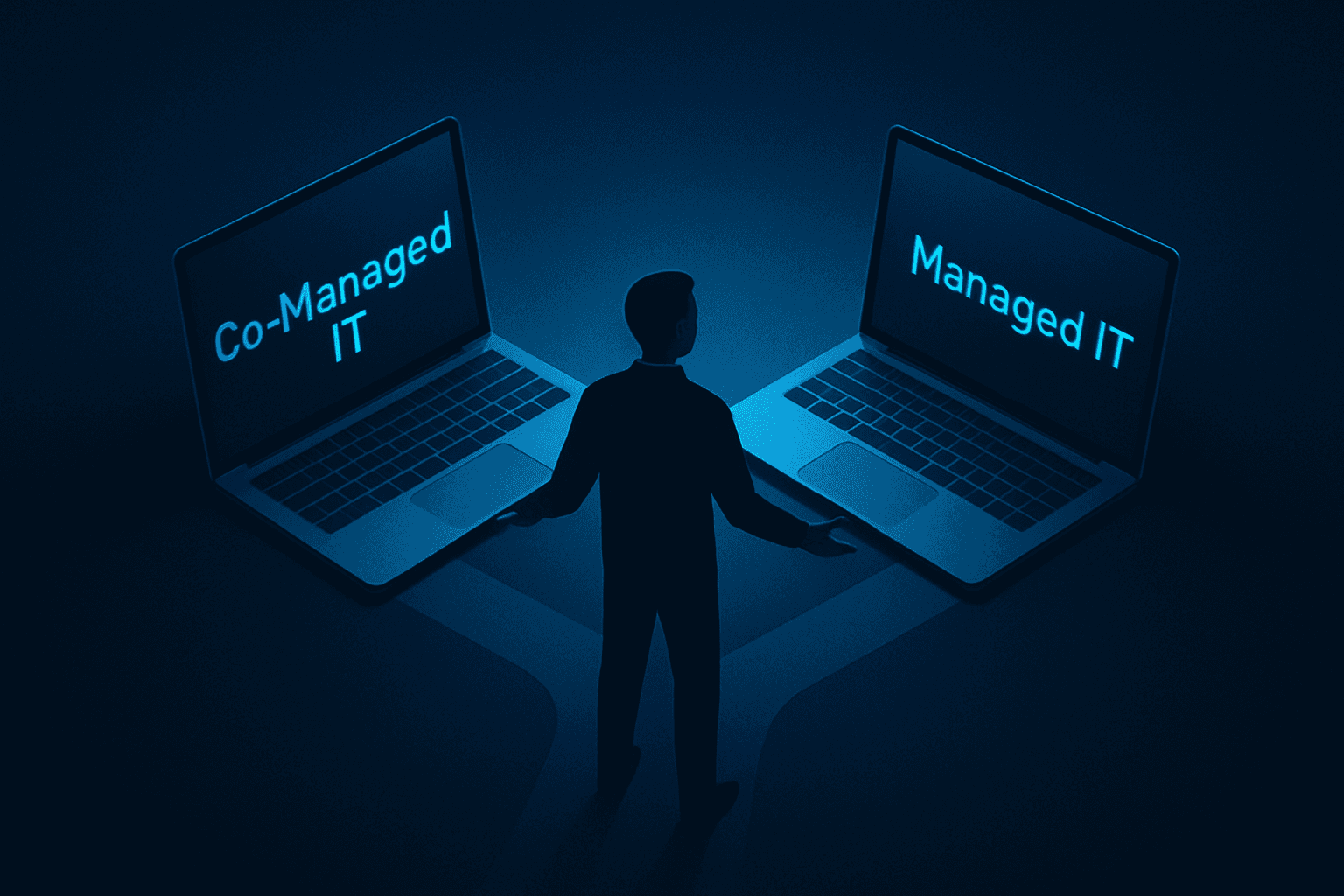
Co-managed IT vs. fully managed IT: which model is right for your Orange County business?
It's Friday afternoon. Your production floor goes quiet because a server is down, your internal IT person is on vacation, and your "backup" is someone in accounting who's good with computers. Sound familiar? The choice between co-managed IT vs managed IT determines whether that Friday becomes a two-hour fix or a two-day disaster. This piece breaks both models down honestly — costs, control, coverage — so you can make the call with clear eyes.
What each model actually means
Before you compare, get the definitions straight.
Fully managed IT means the MSP becomes your IT department — help desk, infrastructure, cybersecurity, cloud management, and strategic planning. Your leadership team interacts with the MSP the same way they'd interact with an internal IT director. No internal IT staff required.
Co-managed IT means the MSP works alongside your existing IT person or small team. You keep institutional knowledge and day-to-day control in-house. The MSP fills the gaps — 24/7 monitoring, advanced security, patching, backup, projects that stretch your team thin. Think of it as expanding your IT bench without adding headcount.
In my experience, this distinction matters most when something goes wrong at the worst possible time. The businesses that weather those moments are the ones that had a team behind them — not a single person holding everything together with duct tape and good intentions.
According to Datto's SMB Market Report, co-managed models are increasingly adopted by smaller organizations that want to keep a trusted IT lead but offload operational burden and advanced security. It's no longer just an enterprise play.
The honest side-by-side
| Fully Managed IT | Co-Managed IT | |
|---|---|---|
| Who owns IT day-to-day | The MSP | Shared — internal IT + MSP |
| Best fit | No internal IT staff, or leadership wants IT fully off their plate | At least one capable internal IT person who needs capacity, coverage, or security depth |
| Cost structure | Higher per-user monthly fee, but replaces salaries and benefits | Lower per-user fee layered on top of existing salary |
| Control level | Low (MSP decides and executes) | High (internal IT retains ownership, MSP handles overflow) |
| 24/7 coverage | Included | Included via MSP layer |
| Scales with headcount | Yes | Yes |
| Best for risk profile | Companies with no internal expertise facing heightened cyber exposures | Companies that must retain internal knowledge but need professionalized security |
Industry benchmarks from Sagiss put fully managed IT around $150–$195 per user or device, per month, while co-managed IT typically runs $50–$155 per user or device, per month, reflecting the shared workload.
For context, a single qualified IT manager can command a substantial salary — before benefits, training, or PTO coverage. Fully managed often beats that math when you factor in the full team of specialists you're getting.
How should a business evaluate the ROI of each model?
This is the question most CFOs actually care about — and it's the right one to ask.
Organizations leveraging managed IT services commonly report meaningful cost reductions and efficiency gains in the first year — though the specific return varies by organization size, existing infrastructure, and the scope of services engaged. Broader outsourcing analyses similarly suggest that shifting from purely in-house IT operations to a managed model delivers significant cost savings for most businesses.
For a co-managed engagement, the ROI calculation is different. Your internal IT person's salary stays. What changes is what they can accomplish. JumpCloud-backed data shows 57% of IT teams say their MSP increased their effectiveness at managing IT — co-managed arrangements typically improve internal IT performance rather than replace it.
Your IT person stops drowning in tier-1 tickets and starts doing the work that actually moves your business forward.
For a fully managed engagement, the ROI question is simpler: what does it cost to have HD Tech run your IT at a predictable monthly rate, versus what it costs you to hire, train, retain, and manage a full internal team?
For most Orange County businesses without a large internal IT department, the fully managed model wins that comparison — and it's not close.
What does the Orange County threat landscape actually look like?
It's not if, it's when. And in Orange County, the "when" is arriving faster than most business owners expect.
Small businesses globally face a disproportionate share of cyberattacks compared to larger enterprises — research tracking confirmed breaches finds that small businesses faced nearly 4x more confirmed breaches than large organizations. Orange County SMBs are no exception. That's not a reason to panic — it's a reason to be deliberate about which model gives you the coverage you actually need.
The vast majority of SMEs now rely on a managed service provider for at least some IT functions. The question isn't whether to bring in outside expertise — it's how much.
I've watched Orange County manufacturers grind through ransomware events that knocked out production for days. Every single one of them said the same thing afterward: "We thought we were covered." The model you choose — and how seriously you implement it — determines whether you're covered or just comfortable.
If your internal IT person is spending most of their day resetting passwords, troubleshooting printer issues, and chasing down software licenses, that's a co-managed IT conversation. They have capacity — they just need the operational load lifted so they can focus on higher-value work.
If your "IT department" is someone in accounting who's good with computers, or a part-time contractor who checks in monthly, that's a fully managed IT conversation. You need a real team in your corner, not a Band-Aid.
For manufacturers and professional services firms in Orange County, we've covered the co-managed model in more depth — see our piece on co-managed IT in Orange County and specifically co-managed IT for manufacturing in Orange County if that's your industry.
Common misconceptions that trip up the decision
Trust, yet verify — especially when it comes to the assumptions your business is running on right now. Here are the ones I hear most often.
"Fully managed always costs more." Not once you account for the full cost of internal staff. Salary, benefits, training, coverage gaps, after-hours incidents — it adds up fast. Many businesses running the honest math find fully managed comes in lower than their current in-house cost.
"Co-managed IT is just for large enterprises." Datto's SMB Market Report says otherwise. Smaller organizations are adopting the co-managed model precisely because they want to keep a trusted internal person without that person being the single point of failure for their entire IT operation.
"Outsourcing IT means losing control." Co-managed IT is specifically designed to preserve internal ownership. Your IT person doesn't go anywhere — they gain a team behind them.
"My IT person has it handled — we don't need an MSP." This is the Nephew Solution dressed up in a polo shirt. Having one capable internal person is genuinely better than nothing. But one person — no matter how talented — cannot provide 24/7 monitoring, run a security function, manage patching at scale, and execute strategic projects at the same time.
When they're sick, on vacation, or burned out, your entire IT operation is exposed. That's not a knock on them. It's just math. A capable IT person deserves a team behind them, not a solo act with no backup.
How HD Tech approaches both models
HD Tech works with Orange County businesses on both models — and we don't push one over the other. We push the one that's right for your situation.
Over the years, the businesses that struggle most aren't the ones without a big IT budget. They're the ones that guessed instead of planned. The Lifeguard Loop™ — our Listen & Learn, Implement & Integrate, Fortify & Future-Proof, Educate & Empower framework — starts with an honest assessment of where you actually are before we recommend anything.
What's consistent across both:
- Flat monthly fee. No surprise invoices. No "break-fix" charges after an incident. You know the number before the month starts.
- Fast help desk response. Your people aren't sitting on hold. When something breaks, someone picks up — fast.
- Proactive monitoring. Whether we're your entire IT department or your IT team's backstop, we're watching your environment around the clock through our Relentless Response Engine™.
- Plain-English communication. You'll know what's happening with your IT without needing a translator. That's the Plain-English Promise™.
Kathleen Urquidez, President & Managing Partner at Urquidez & Associates CPAs, put it plainly:
"HD Tech has been our 'in-house' IT department for many years. We can't thank them enough for making our IT as streamlined as possible with a concentrated focus on our data security. Downtime means lost billing — with HD Tech on our side we have close to no interruptions."
That's a fully managed engagement. For businesses where an internal IT person is already doing solid work, our co-managed IT services model layers our team in to cover the gaps — security depth, 24/7 response, and project capacity — without disrupting what's already working.
For businesses ready to hand IT off completely, our managed IT services give you a full team, a predictable monthly cost, and a partner who treats your business the way you treat your best clients.
Either way, you're not in this alone. For more on what fully managed looks like for Orange County businesses specifically, see our managed IT services overview for Orange County.
Frequently Asked Questions
Fully managed IT means an MSP runs your entire IT department — help desk, infrastructure, security, and strategy — with no internal IT staff required. Co-managed IT means the MSP works alongside your existing internal IT person or team, handling overflow, 24/7 monitoring, and advanced security while your in-house staff retains control and institutional knowledge. The right model depends on how much internal IT capacity you already have.
Co-managed IT typically costs less per user ($50–$155/month versus $150–$195/month for fully managed), but that comparison doesn't tell the whole story. If you're paying a full-time IT manager a substantial salary plus benefits, fully managed IT may cost less in total — and delivers a full team of specialists rather than one person. Run the full-cost comparison before assuming co-managed is always the cheaper option.
Yes. The co-managed model is increasingly common among small and mid-sized businesses that have at least one internal IT person but need additional capacity, 24/7 security monitoring, or help desk depth. It's particularly well-suited to Orange County manufacturers, professional services firms, and other businesses where an internal IT lead handles relationships and institutional knowledge while the MSP handles operations and security.
If your business has no dedicated internal IT staff, if your current IT support is reactive rather than proactive, or if your leadership team wants IT completely off their plate with predictable monthly costs, fully managed IT is the right conversation. It's also the right move if a single internal IT person is your entire IT operation — because one person cannot cover 24/7 monitoring, advanced security, and day-to-day support simultaneously.
Yes. HD Tech works with businesses on both co-managed and fully managed engagements, and the right model can change as your headcount, complexity, and risk profile evolve. Some businesses start fully managed and hire an internal IT person as they grow, shifting to co-managed. Others start co-managed and transition to fully managed when their internal IT person moves on. Either way, your IT coverage stays consistent.
Figuring out which model fits your business doesn't have to be a guessing game. Book your free Discovery Call with Tom Hermstad — extensive IT and cybersecurity experience, no jargon, no pressure. You'll leave with a clear read on where you stand and which model actually makes sense for your size, your team, and your risk exposure. Book your free Discovery Call at hdtech.com/contact.

Tom Hermstad
President & CMO, HD Tech
Tom Hermstad has led HD Tech since 1995, building one of Southern California's most trusted managed IT and cybersecurity firms. He specializes in helping Orange County businesses eliminate IT headaches and stay ahead of evolving cyber threats — in plain English.